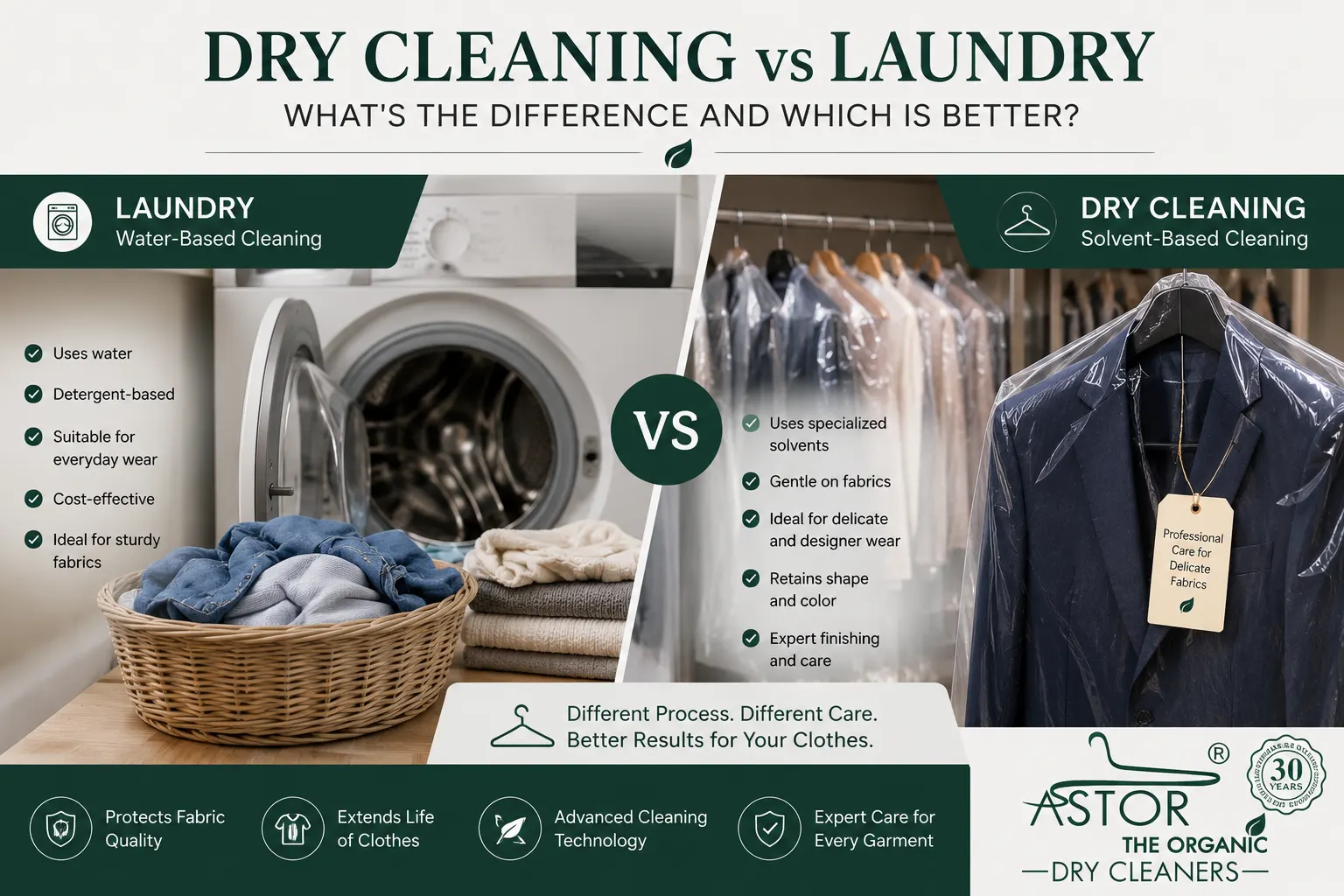
Dry Cleaning vs Laundry is not really a competition between two universally better or worse methods. The right choice depends on what you are cleaning, what the fabric can tolerate, how the garment is constructed and what the care label recommends.
A cotton T-shirt, wool blazer, silk saree and heavily embellished bridal lehenga should not automatically be treated in the same way. Laundry relies on water, detergent and mechanical action, while dry cleaning uses a liquid solvent with little or no water as the primary cleaning medium. Professional wet cleaning is another water-based option in which the cleaner can precisely control factors such as detergent, temperature, water level and mechanical action.
So, dry cleaning vs laundry should really be viewed as a question of appropriate garment care.
For everyday washable clothing, laundry may be the practical choice. For certain structured, delicate or solvent-suitable garments, professional dry cleaning may be more appropriate. And for some garments, a professional cleaner may recommend a different treatment altogether.
Let's understand the difference.
Dry Cleaning vs Laundry: What's the Core Difference?
The fundamental difference is the cleaning medium.
Laundry uses water as the primary cleaning medium, generally together with detergent and mechanical action. Dry cleaning uses a liquid solvent rather than water as the primary cleaning medium. Despite its name, dry cleaning is not literally dry—the garments are immersed in a liquid solvent during cleaning and subsequently dried.
What Is Laundry?
Laundry is a water-based cleaning process.
During conventional machine washing, garments are exposed to water, detergent and mechanical movement. Depending on the selected cycle, the process may include soaking, agitation, rinsing and spinning before drying.
This makes laundry suitable for many everyday garments that are designed to tolerate water and normal washing conditions.
Cotton T-shirts, many casual shirts, towels, bedsheets and other washable household textiles commonly fall into this category.
The important variable, however, is not simply the fabric name. The garment's care label, construction, dye stability and finish also matter.
What Is Dry Cleaning?
Dry cleaning uses a liquid solvent rather than water as the main cleaning medium.
The Drycleaning & Laundry Institute explains that dry cleaning uses fluids to remove soils and stains and that the process can be followed by professional finishing using specialised pressing equipment.
One advantage is that solvents can dissolve oils and greases differently from water-based cleaning. This can make solvent-based cleaning particularly useful for certain garments and soil types.
However, dry cleaning is not automatically the safest choice for every item. Professional cleaners should consider the garment's care label, fabric and construction before selecting a process.
How Does Dry Cleaning Work?
Although the cleaning machine is central to dry cleaning, professional garment care starts before the garment enters the machine.
A typical professional process can involve:
Inspection → stain treatment → cleaning → drying → finishing → quality inspection → packaging
The cleaner first identifies stains and vulnerable areas. Garments are then cleaned in specialised equipment using an appropriate solvent. The solvent is filtered or otherwise managed during the process, and the garments are dried before being finished and pressed.
At Astor, this principle is expanded into a Seven-Stage Garment Care Process covering detailing, stain removal, cleaning, hand finishing, minor repairs, inspection and packaging.
That distinction is important.
Professional dry cleaning isn't simply:
“Put clothes in machine → remove clothes.”
The quality of the result can depend heavily on what happens before and after the machine cycle.
How Does Laundry Work?
Conventional laundry uses water, detergent and mechanical action to loosen and remove soil.
The exact process varies according to the garment and wash cycle. A normal wash can include:
Water + detergent → washing/agitation → rinsing → extraction → drying
Modern washing machines also provide different cycles for different requirements. The American Cleaning Institute, for example, distinguishes normal/cotton, delicate, heavy-duty and quick-wash settings because different textiles and soil levels require different treatment.
Professional laundering can provide considerably more control than simply putting clothes into a household washing machine.
Professional wet cleaning, for instance, uses specialised equipment to control variables such as detergent concentration, water level, temperature and rotation speed to help reduce the risk of shrinkage, colour loss and fabric distortion.
Dry Cleaning vs Laundry: Key Differences at a Glance
| Factor | Laundry | Dry Cleaning |
|---|---|---|
| Primary cleaning medium | Water | Liquid solvent |
| Detergent | Commonly used | Specialised cleaning agents may be used |
| Mechanical action | Yes | Yes, but process differs |
| Best suited to | Many washable everyday garments | Certain delicate, structured or solvent-suitable garments |
| Oil/grease cleaning | Can be effective depending on detergent/process | Solvents can be particularly effective on oily soils |
| Shrinkage risk | Depends on fabric, temperature and process | Different risk profile; garment-specific assessment still matters |
| Colour behaviour | Depends on dye and wash conditions | Depends on dye, solvent and garment |
| Finishing | May involve ironing or pressing | Professional pressing/finishing commonly follows |
| Care label importance | Very high | Very high |
| Universally better? | No | No |
The most important takeaway is the last row.
Neither method wins every time.
Which Clothes Are Better Suited to Laundry?
Laundry is generally appropriate when a garment is designed to tolerate water-based cleaning.
Typical examples include:
- Many cotton T-shirts
- Everyday casual shirts
- Washable trousers
- Towels
- Bedsheets
- Many polyester garments
- Washable everyday clothing
- Certain sportswear and activewear
But even within these categories, the care label should be checked.
For example, two garments made primarily from cotton can behave differently because of differences in dye, construction, finishing, blends or manufacturing.
A washable garment can also be damaged by excessive heat, unsuitable detergent, aggressive agitation or incorrect drying.
So “it's cotton” is not enough information to determine the correct cleaning process.
Which Clothes Are Better Suited to Dry Cleaning?
Dry cleaning can be appropriate for garments whose care requirements make water-based washing less suitable.
Common examples include certain:
- Suits
- Blazers
- Structured coats
- Wool garments
- Silk garments
- Velvet pieces
- Designer clothing
- Embellished garments
- Couture pieces
- Formalwear
The key word is certain.
A silk garment does not automatically mean “dry clean it,” just as a cotton garment does not automatically mean “put it in the washing machine.”
The care label and garment assessment should guide the decision. The DLI's care-label guidance specifically distinguishes standard drycleaning, professional drycleaning, hand washing, machine washing and other care instructions.
Dry Cleaning vs Laundry for Different Fabrics
Cotton
Cotton is commonly associated with laundry because many cotton garments can tolerate water-based washing.
However, cotton can still shrink, fade or lose its shape if exposed to unsuitable temperatures or aggressive washing and drying.
Typical choice: Laundry, when the care label permits it.
Wool
Wool requires more careful handling because moisture, heat, agitation and friction can affect its structure.
A wool suit or tailored wool garment may have additional construction layers that make ordinary washing unsuitable.
Typical choice: Professional cleaning according to the care label, often including dry cleaning for appropriate garments.
Silk
Silk is delicate and can respond poorly to unsuitable water temperature, agitation or other cleaning conditions.
Its colour, finish and texture also need consideration.
Typical choice: Follow the garment's care instructions and consider professional cleaning when required.
Polyester and Other Synthetics
Many synthetic garments are washable and can tolerate regular laundering.
But synthetics can still have specialised finishes, coatings or blends that change their care requirements.
Typical choice: Laundry when the label permits it; professional cleaning where specified.
Denim
Many denim garments can be laundered, but washing temperature, frequency and drying method can affect colour and fit.
Typical choice: Laundry according to the care instructions.
Embroidered and Embellished Garments
This is where things become more complicated.
Beads, sequins, embroidery, metallic details, glued elements and other decorative features can react differently to water, heat, agitation or solvents.
A heavily embellished garment therefore needs more than a simple fabric-based decision.
Typical choice: Professional assessment before cleaning.
For high-value wedding or couture clothing, this assessment becomes particularly important.
Astor's wedding and couture services are specifically designed around garments with delicate embellishments and specialised construction.
Is Dry Cleaning Better Than Laundry?
Not universally.
This is perhaps the most important answer in the entire article.
Dry cleaning can be the more appropriate option for certain garments, while laundry is the better choice for many everyday washable items.
The wrong cleaning method can potentially contribute to problems such as:
- Shrinkage
- Colour change
- Loss of shape
- Texture changes
- Damage to embellishments
- Premature fabric wear
Experts therefore recommend looking at the specific garment rather than treating dry cleaning or laundry as universally superior. The Washington Post's expert guidance similarly stresses that the right approach for delicate clothing depends on fabric, construction and care instructions.
The question shouldn't be:
“Is dry cleaning better?”
It should be:
“Which cleaning method is appropriate for this garment?”
That is a much more useful way to think about garment care.
Why the Care Label Should Come First
The small label inside your clothing can tell you more about the appropriate cleaning method than assumptions based on fabric type.
Common instructions include:
- Machine wash
- Hand wash
- Dryclean
- Professionally dryclean
- Spot clean only
- Tumble dry
- Line dry
- Dry flat
- Iron with specific temperature limitations
The DLI explains that care labels communicate these instructions and that professional cleaners can help consumers interpret them.
There can also be situations where a professional cleaner recommends a method different from the label based on garment experience, stains or fabric characteristics. DLI notes that such alternatives can carry additional risk and may require customer approval.
So don't cut out the label simply because you find it uncomfortable.
That tiny label can protect an expensive garment from a very expensive mistake.
What About Stains? Is Dry Cleaning Always Better?
Not necessarily.
The type of stain matters.
Water-soluble soils and oily soils can behave differently, and the effectiveness of a cleaning method depends on the stain, fabric and treatment.
Professional dry cleaning has an advantage for certain oily soils because solvents can dissolve greases and oils in ways that water alone cannot.
But professional cleaning does not mean every stain will disappear.
A stain that has been exposed to heat, repeatedly treated at home or allowed to oxidise may become much more difficult to remove.
That is why early disclosure matters.
If you spill coffee, makeup, oil or another substance on an expensive garment, tell the cleaner what happened rather than simply saying “there's a stain.”
That information can help the professional select an appropriate treatment.
When Should You Choose Laundry?
Choose laundry when:
The care label permits machine or hand washing, and the garment is designed to tolerate water-based cleaning.
This commonly includes everyday clothing and household textiles.
Laundry can also be the more practical choice when the main objective is removing everyday water-soluble soils, sweat and general dirt from durable washable garments.
However, “washable” doesn't mean “wash however you want.”
Correct temperature, detergent, cycle, drying method and frequency still matter.
When Should You Choose Dry Cleaning?
Professional dry cleaning deserves consideration when:
The care label specifies dry cleaning, or when the garment's material, structure or decoration requires specialist handling.
This can include certain:
- Suits and blazers
- Wool coats
- Silk garments
- Structured dresses
- Designer clothing
- Embellished outfits
- Couture garments
- Wedding attire
If you're unsure, don't guess.
A professional cleaner can assess the garment and determine the appropriate treatment.
When Is Professional Garment Care Better Than DIY Cleaning?
The more valuable, delicate or complicated the garment, the less sensible it becomes to experiment.
Consider professional care when the garment has:
- Complex construction — such as tailoring, structured jackets or layered garments.
- Delicate materials — such as certain silks, woollens, cashmere or velvet.
- Embellishments — including beads, sequins, embroidery or decorative elements.
- Sentimental value — such as wedding outfits, heirloom garments or vintage clothing.
- Difficult stains — particularly when you are unsure what caused them or how to treat them.
- High financial value — when the cost of replacing the garment greatly exceeds the cost of professional care.
This is where professional expertise becomes valuable.
How Astor Approaches Dry Cleaning and Laundry
At Astor The Organic Dry Cleaners, the approach isn't based on automatically putting every garment through one cleaning process.
The company's Seven-Stage Garment Care Process begins with detailing and inspection, followed by stain removal and selection of an appropriate cleaning method. Its process information states that this can involve hand cleaning, laundering or dry cleaning, depending on the garment.
The process then continues through hand finishing, minor repairs, final inspection and packaging.
That approach is especially relevant for customers who have a mixed wardrobe.
Your everyday cotton shirts may need one type of care.
Your business suits may need another.
Your silk saree, bridal lehenga or designer garment may require something more specialised.
Astor's broader service portfolio reflects this distinction, with dedicated services for dry cleaning, signature shirts, wedding and bridal garments, couture garment care, leather and suede, shoes and bags, and home textiles.
For customers in Gurugram, the brand also combines professional garment care with doorstep pickup and delivery, making it possible to have different types of garments assessed and handled through one professional service.
Frequently Asked Questions
Is dry cleaning better than laundry?
No method is universally better. Laundry is suitable for many washable everyday garments, while dry cleaning can be more appropriate for certain delicate, structured, embellished or dry-clean-only garments.
What is the main difference between dry cleaning and laundry?
Laundry primarily uses water and detergent, while dry cleaning uses a liquid solvent with little or no water as the primary cleaning medium.
Can I wash clothes marked “dry clean only”?
You should generally follow the garment's care instructions rather than assuming it is safe to wash. A professional cleaner can assess the garment if you are unsure.
Is dry cleaning safer for delicate clothes?
It can be more appropriate for certain delicate garments, but dry cleaning is not automatically safer for every delicate fabric. The fabric, construction, dye, embellishments and care label all matter.
Which is better for everyday clothes: laundry or dry cleaning?
For many durable, washable everyday garments, laundry is generally the appropriate choice. Dry cleaning is usually unnecessary unless the garment's care requirements specify or justify it.
Is dry cleaning better for suits?
Many structured suits are professionally dry cleaned because their fabric and construction may not be suited to ordinary washing. Always follow the care label and professional advice.
Can silk be washed instead of dry cleaned?
Some silk garments can be hand washed or otherwise water-cleaned, while others require professional dry cleaning. The care label and garment construction should determine the method.
Does dry cleaning remove more stains than laundry?
Not necessarily. Different cleaning methods work differently on different types of stains. Dry-cleaning solvents can be particularly effective against certain oily soils, while other stains may require specialised pre-treatment.
How do I know whether a garment needs dry cleaning?
Start with the care label. If you're still unsure, consider the garment's fabric, construction, embellishments and value and ask a professional cleaner to assess it.
Can a professional cleaner decide between laundry and dry cleaning?
Yes. Professional garment-care providers can assess the garment and determine an appropriate cleaning process based on the care label, material, construction, stains and other factors.
Conclusion
Dry Cleaning vs Laundry isn't really about declaring one cleaning method the winner.
Laundry uses water-based cleaning and is appropriate for a wide range of everyday washable garments. Dry cleaning uses specialised liquid solvents and can be particularly useful for certain delicate, structured, embellished and dry-clean-only garments. Professional wet cleaning provides another water-based option when controlled treatment is appropriate.
The better approach is to look at the garment first.
Check its care label. Consider its fabric and construction. Think about stains and embellishments. And when a garment is expensive, delicate, sentimental or complicated, professional assessment can be a much safer choice than experimenting at home.
That is ultimately the philosophy behind professional garment care at Astor The Organic Dry Cleaners: the objective isn't to force every garment into the same cleaning process, but to determine the appropriate treatment and then handle the garment carefully through cleaning, finishing and inspection.
Clean clothing is the outcome. Appropriate garment care is the real goal.
Schedule your pickup or explore Astor's dry cleaning services.