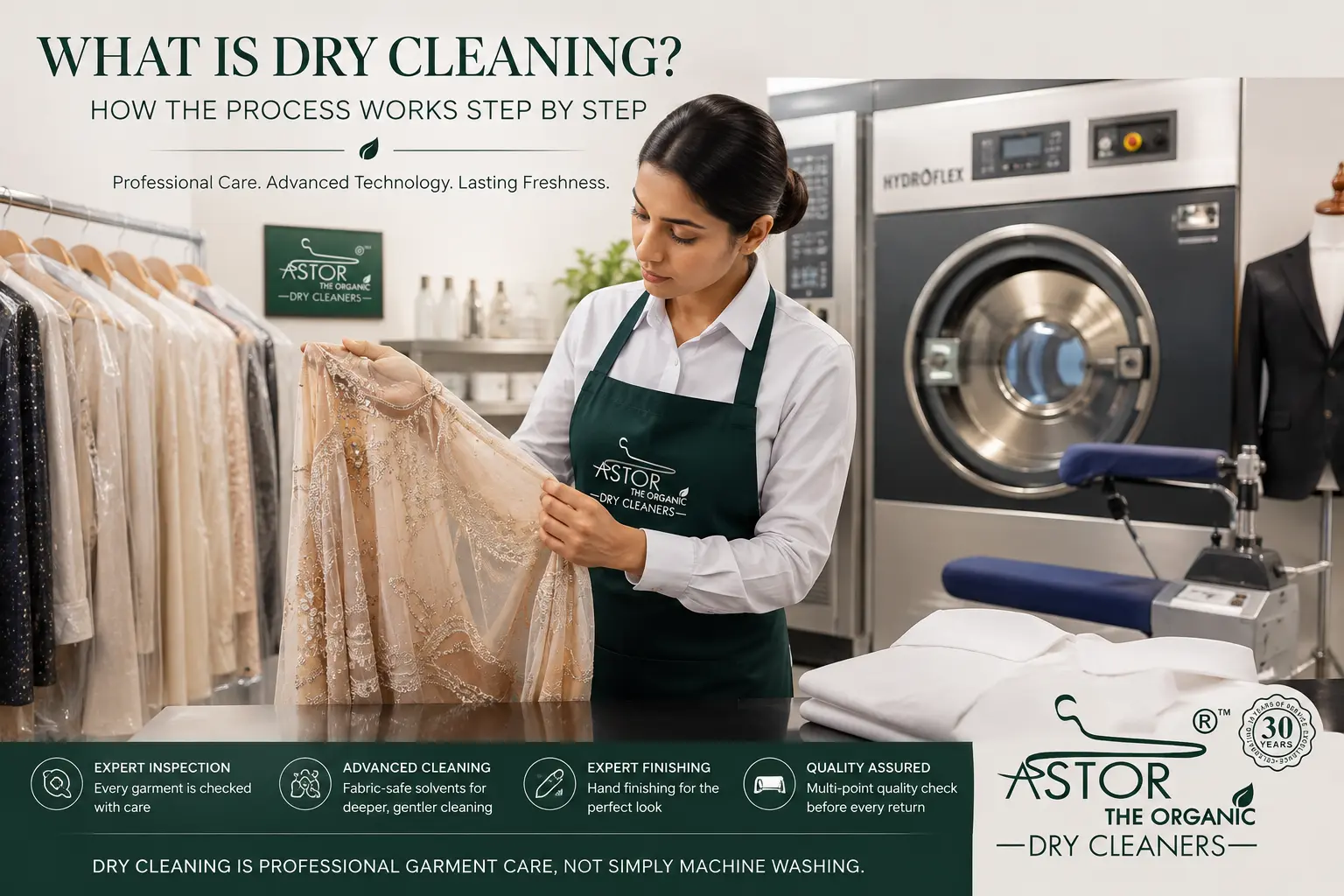
If you have ever handed over a silk saree, business suit, wool coat or embellished dress to a dry cleaner, you may have wondered what actually happens after the garment disappears behind the counter.
What is dry cleaning, exactly? Is it really “dry”? What liquid is used? Why can't certain clothes simply be washed at home? And how does a professional cleaner remove stains without damaging delicate fabrics?
Dry cleaning is a specialised textile-cleaning process that uses a liquid solvent instead of water as the primary cleaning medium. But the machine cycle is only one part of the story. Professional garment care also involves inspection, stain treatment, fabric assessment, finishing, quality control and careful packaging.
At Astor The Organic Dry Cleaners, this broader approach is central to its Seven-Stage Garment Care Process. The company assesses garments before choosing an appropriate treatment and follows the item through detailing, stain removal, cleaning, hand finishing, minor repairs, inspection and packaging.
Let's look at what happens, step by step.
What Is Dry Cleaning?
Dry cleaning is a professional cleaning method in which garments and other textiles are cleaned using a liquid solvent other than water.
The name can be slightly misleading. The clothes are not literally kept dry throughout the process. Instead, the term “dry cleaning” distinguishes solvent-based cleaning from conventional water-based laundering. The solvent performs much of the cleaning work that water and detergent perform during ordinary washing.
This difference matters because water can interact with certain fibres, dyes, finishes and garment constructions in ways that may lead to shrinkage, distortion, colour changes or changes in texture. Non-aqueous cleaning solvents can behave differently and can be particularly useful for certain oily soils and garments that require specialised handling.
However, dry cleaning is not automatically the right choice for every garment. The fabric, construction, care label, embellishments, existing damage and type of soil all matter. Professional cleaning is about selecting the appropriate method rather than putting every item through the same cycle.
How Does the Dry Cleaning Process Work Step by Step?
A professional dry cleaning process involves considerably more than placing clothes inside a machine.
Industry guidance describes the wider process as a sequence that can include garment intake and tagging, stain removal, cleaning, finishing, inspection, assembly and packaging.
Astor takes a similarly comprehensive approach through its Seven-Stage Garment Care Process. Here's what each stage means.
Garment Inspection and Detailing
The first step is understanding the garment before attempting to clean it.
A professional cleaner needs to identify the fabric or fibre composition, examine the garment's construction and look for visible stains, marks, loose buttons, open seams, embroidery, embellishments and other vulnerable details.
Astor calls this stage detailing. Its specialists inspect the garment's fabric type and composition, document marks or imperfections and take appropriate precautions with buttons, embellishments and other delicate components.
This is an often-overlooked part of dry cleaning.
A garment is not simply a piece of fabric. A heavily embroidered lehenga, for example, may require very different handling from a wool blazer or cotton shirt.
That is why professional garment care begins with assessment rather than cleaning.
Stain Identification and Pre-Treatment
The next stage focuses on stains.
Different stains behave differently. Oil, grease, makeup, coffee, wine, perspiration, food and ink do not necessarily respond to the same treatment. Trying to remove a stain using an unsuitable chemical or excessive mechanical action can sometimes make the situation worse.
Professional stain treatment therefore involves identifying the mark and selecting an appropriate treatment before or alongside the main cleaning process.
Astor's process specifically separates stain removal from the main cleaning stage. Its specialists identify marks during detailing and use appropriate traditional and modern techniques to address them while considering the sensitivity of the garment.
This distinction is important: dry cleaning and stain removal are not exactly the same thing.
A solvent-based cleaning cycle may remove many soils effectively, but particularly visible or difficult stains may require targeted attention.
Fabric-Specific Cleaning
Once the garment has been assessed and stains have been treated as appropriate, the cleaner determines the most suitable cleaning method.
This is the stage most people traditionally associate with dry cleaning.
In a solvent-based dry cleaning process, garments are placed inside a specialised machine where a cleaning solvent circulates through the load. The solvent interacts with soils on the fabric, while mechanical movement helps loosen and carry those soils away. The solvent is subsequently extracted and the garments are dried.
Modern dry-cleaning systems can also incorporate filtration and solvent recovery, allowing the cleaning fluid to be processed and reused rather than simply discarded.
But professional cleaning does not necessarily mean dry cleaning every garment.
Astor's own process states that, depending on the material and construction, its specialists may choose hand cleaning, laundering or dry cleaning.
That is a crucial point for consumers: the best cleaning method is the one appropriate for the garment—not necessarily the one with “dry cleaning” written on the receipt.
Solvent Extraction and Drying
After the cleaning stage, the solvent needs to be removed from the garments.
The machine uses extraction to separate much of the solvent from the fabric. In modern dry-to-dry systems, washing, extraction and drying can take place within the same machine.
During drying, controlled air and temperature conditions help remove remaining solvent from the garments. Proper control is important because excessive heat can be unsuitable for certain textiles.
The solvent itself may also pass through filtration or recovery systems as part of the machine's operating cycle.
This is one reason professional dry cleaning should not be confused with simply “washing clothes with a different liquid.” The equipment, solvent management, mechanical action, temperature control and operator knowledge all influence the outcome.
Hand Finishing and Pressing
Cleaning is not the end of the process.
A garment can be technically clean and still not look ready to wear.
It may have wrinkles, require reshaping or need careful attention around collars, cuffs, pleats, seams and other structural details.
Professional finishing restores the garment's presentation after cleaning. Depending on the item, this can involve pressing, steaming, shaping or hand finishing.
Astor specifically treats hand finishing as the fourth stage of its garment-care process, with finishing techniques selected according to the garment and its requirements.
This is particularly important for formal shirts, suits, dresses, sarees and designer garments where the final appearance matters almost as much as cleanliness.
Minor Repairs and Garment Care
One of the more distinctive elements of Astor's process is that garment care does not necessarily stop at cleaning.
During inspection, professionals may notice a loose button, open seam, small hem issue or another minor problem.
With customer approval, Astor's process can address minor repairs such as securing hems, fixing loose buttons and correcting open seams.
This makes sense from a garment-longevity perspective. A small repair identified early can prevent a minor weakness from becoming a larger problem later.
Final Quality Inspection
Before the garment is returned, it needs another look.
The final inspection checks whether the cleaning and finishing have met the required standard and whether any identified issues have been addressed.
Astor's sixth stage focuses on cleanliness, appearance, repairs and finishing quality before an item moves to packaging.
This final check is especially valuable for delicate or high-value garments.
A stain may have been difficult to remove. An embellishment may require special attention. A fabric may have limitations that affect what can safely be achieved.
Professional quality control helps ensure that these considerations are addressed before the garment reaches the customer.
Packaging and Return
The final stage is packaging.
Clean garments still need to be protected during transportation and before they return to your wardrobe.
Astor uses branded hangers and protective garment covers and says it aims to minimise packaging, recycle where possible and reduce waste as part of its sustainability practices.
For customers using doorstep services, this stage becomes particularly important because the garment has another journey between the cleaning facility and the customer's home or workplace.
Astor combines its garment-care process with doorstep pickup and delivery across Gurgaon, allowing customers to arrange professional garment care without visiting a store for every order.
Why Is Dry Cleaning Used for Certain Clothes?
Not every fabric responds to water, heat, agitation and detergent in the same way.
Certain garments have construction details or materials that make conventional laundering less suitable. Structured tailoring, delicate fibres, intricate embellishments and certain finishes may require more controlled cleaning and finishing.
Silk, wool, cashmere, velvet, embellished garments and luxury clothing are common examples where professional assessment can be particularly useful.
However, it is important not to turn this into a blanket rule that says every silk or wool garment must always be dry cleaned. Care labels and professional assessment should guide the cleaning method.
Astor's service model reflects this principle by assessing the garment first and choosing between dry cleaning, laundering, hand cleaning or specialised treatment depending on its characteristics.
Dry Cleaning vs Laundry: What's the Difference?
The simplest distinction is the cleaning medium.
Laundry generally uses water-based cleaning, while dry cleaning uses a non-water solvent as the primary cleaning medium.
But the practical difference goes further.
Laundry is commonly appropriate for washable everyday garments where water, detergent and mechanical action are compatible with the fabric and construction.
Dry cleaning can be useful where solvent-based cleaning is better suited to the garment's material, structure or soil profile.
There is no universal “better” method.
The right question is:
Which cleaning method is safest and most effective for this particular garment?
That is precisely why garment inspection matters.
What Types of Clothes Can Be Professionally Dry Cleaned?
Depending on the care instructions and garment construction, professional dry cleaning may be appropriate for items such as:
- Suits and formalwear
- Blazers and coats
- Silk garments
- Sarees
- Designer dresses
- Wedding and bridal wear
- Embellished garments
- Woollen clothing
- Certain delicate fabrics
- Couture garments
Astor's dry-cleaning service also extends to specialised items such as vintage curtains, antique carpets, wedding dresses, couture pieces, luxury bags and shoes.
The important qualification is that the care label and professional assessment should determine the treatment.
Is Dry Cleaning Better for Expensive or Delicate Clothes?
It can be, when the cleaning method is appropriate for the garment.
The value of professional dry cleaning is not simply the solvent used. It is the combination of fabric knowledge, inspection, stain treatment, controlled cleaning, finishing and quality control.
For an expensive designer dress, for example, the biggest risk may not be ordinary dirt. It may be the embroidery, colour, construction, trims or embellishments.
Astor's approach is built around assessing these details before cleaning, which is particularly relevant to couture and luxury garments.
What Makes Professional Dry Cleaning Different From Home Cleaning?
Home washing gives consumers convenience and control, but it also puts the responsibility for choosing the right method entirely on them.
A professional dry cleaner brings specialised equipment and process knowledge to the job.
More importantly, professional garment care involves decisions before, during and after cleaning.
That includes:
- What is the fabric?
- What caused the stain?
- Is the garment structurally sound?
- Are the buttons or embellishments vulnerable?
- Which cleaning method is appropriate?
- How should it be finished?
- Does it need a minor repair?
- Is it ready to return to the customer?
This is why the professional dry cleaning process is better understood as garment care, rather than simply machine cleaning.
Is Eco-Friendly Dry Cleaning Available?
Yes, but “eco-friendly dry cleaning” can refer to different technologies and operating practices, so consumers should look beyond the label.
Astor positions itself around environmentally conscious garment care and states that it uses Italian hydrocarbon cleaning technology as well as wet-cleaning approaches and European-standard cleaning agents.
Its broader garment-care information also highlights sustainability practices around cleaning and packaging.
The important consideration is not simply whether a cleaner uses the word “organic” or “green.” Ask what cleaning technology is actually being used, how garments are handled, how solvents are managed and what measures are taken to reduce waste.
How Long Does Dry Cleaning Take?
Turnaround time depends on the garment, service selected, workload and whether specialised or express treatment is required.
A simple everyday garment may require a different timeline from a heavily embellished bridal outfit, couture garment, leather item or large home textile.
Astor also offers pickup and express options in Gurgaon, subject to service eligibility.
For an important event, it is always better to plan ahead rather than assume every garment can be processed safely at short notice.
How to Get Better Results From a Dry Cleaner
Before sending a garment for professional cleaning, check its care label and mention any stains or concerns you already know about.
If you have spilled something on a delicate garment, avoid aggressive rubbing or experimenting with multiple home remedies. Tell the cleaner what caused the stain and approximately when it occurred.
Also mention if the garment has:
- Delicate embroidery or embellishments
- Previous repairs
- Loose buttons or seams
- Colour-transfer concerns
- A particularly valuable or sentimental nature
The more useful information the cleaner has at intake, the better the treatment decision can be.
Why Astor Takes a Seven-Stage Approach to Dry Cleaning
For Astor The Organic Dry Cleaners, professional dry cleaning is not defined simply by what happens inside the cleaning machine.
Its Seven-Stage Garment Care Process covers detailing, stain removal, cleaning, hand finishing, minor repairs, inspection and packaging.
That broader approach is particularly useful when the garment is not an ordinary piece of everyday clothing.
A business suit, silk saree, bridal lehenga, couture dress, leather jacket and embellished garment can all have completely different care requirements.
Astor's dry-cleaning service combines this process with more than 35 years of experience, specialist garment care and pickup/delivery convenience in Gurugram.
The result is a more useful way to think about professional cleaning:
The objective isn't simply to make a garment clean. It is to clean it appropriately while protecting its appearance, construction and useful life.
Frequently Asked Questions About Dry Cleaning
What is dry cleaning in simple words?
Dry cleaning is a professional textile-cleaning process that uses a liquid solvent instead of water as the primary cleaning medium. The broader process can also include garment inspection, stain treatment, cleaning, finishing, quality control and packaging.
Is dry cleaning actually dry?
No. The term refers to cleaning without water. Garments are exposed to a liquid cleaning solvent during the cleaning cycle, which is then extracted and removed during the drying stage.
Does dry cleaning remove every stain?
No. Stain-removal results depend on the type of stain, how long it has been present, the fabric and previous treatments. Professional cleaners assess stains individually rather than guaranteeing that every mark can always be removed.
Is dry cleaning better than washing?
Neither method is universally better. The appropriate method depends on the garment, fabric, construction, care label and type of soil. Some garments are better suited to water-based laundering, while others may benefit from professional solvent-based cleaning.
Can delicate clothes be dry cleaned?
Some delicate garments can be professionally dry cleaned, but they should be assessed individually. Embellishments, dyes, trims, fabric composition and construction all influence the appropriate treatment.
How does professional dry cleaning protect clothes?
Protection begins before cleaning. Professional cleaners can inspect the garment, identify vulnerable areas, select an appropriate treatment, manage stains, finish the garment carefully and perform a final quality inspection before packaging.
What is the difference between dry cleaning and laundry?
Laundry generally uses water-based cleaning, while dry cleaning uses a non-water solvent. The choice between them should depend on the garment's care requirements rather than simply the level of dirt.
Does Astor offer doorstep dry cleaning?
Yes. Astor provides doorstep pickup and delivery across Gurgaon, alongside its physical locations and professional garment-care services.
Conclusion
What is dry cleaning? It is much more than putting clothes into a machine with a cleaning solvent.
A professional dry cleaning process begins with garment inspection and detailing, continues through stain treatment and fabric-specific cleaning, and ends with finishing, quality inspection and protective packaging. The cleaning cycle itself is only one part of the larger garment-care journey.
That distinction matters because clothes are not all made the same. A silk saree, wool blazer, embellished lehenga, designer dress and everyday shirt can have very different cleaning requirements.
This is also why choosing a professional cleaner should be based on more than convenience or price. Look for experience, appropriate cleaning technology, fabric-specific treatment, careful stain handling and a clearly defined quality-control process.
At Astor The Organic Dry Cleaners, that philosophy is reflected in its Seven-Stage Garment Care Process and specialist approach to everyday, delicate, luxury and wedding garments. With professional cleaning and doorstep pickup available across Gurgaon, garment care can be both technically considered and convenient.
References
- Astor Drycleaners - Seven Stages
- NLM NIH: Dry Cleaning, Some Chlorinated Solvents and Other Industrial Chemicals.
- Science Direct: Dry Cleaning
- Live Science: What is Dry Cleaning
Schedule your pickup or explore Astor's dry cleaning services.